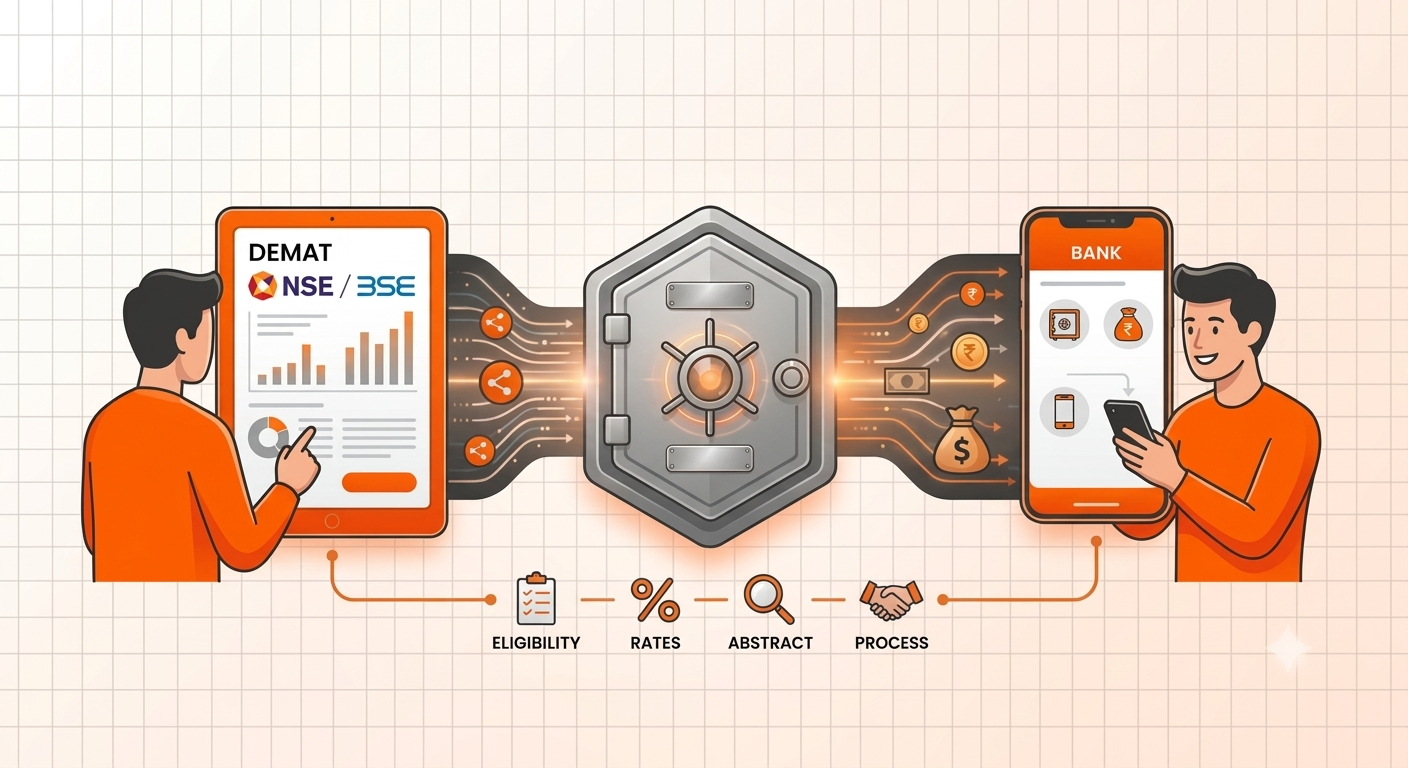
A loan against shares lets investors borrow up to 50% of the current market value of their demat holdings, without selling a single share. On SLiQ, rates start at 9.99% p.a., there's no CIBIL check and no income proof needed, and funds are disbursed within 6 hours. This article covers interest rates, LTV, eligible shares, the application process, and the key risks — including margin calls — so investors can decide if it's the right fit.
1What Is a Loan Against Shares?
A loan against shares is a secured loan where equity shares held in a demat account are pledged as collateral to a lender. The lender sets a credit limit based on the current market value of the pledged shares, and the investor can withdraw funds up to that limit — without selling the underlying shares.
The shares stay in the investor's demat account. A lien (pledge) is marked on the specific shares through NSDL or CDSL, dividends and bonus shares continue to be credited during the loan period, and once the loan is repaid the pledge is released and the shares are fully free again.
The facility is typically structured as an overdraft — interest is charged only on the amount actually withdrawn, not on the full credit limit. Principal can be repaid anytime, and each repayment restores the available credit limit.
2Loan Against Shares vs Selling Shares
| Feature | Loan Against Shares | Selling Shares |
|---|---|---|
| Ownership | Retained | Lost permanently |
| Market upside | Investor still benefits | Missed |
| Dividends | Continue to be paid | Stop |
| Tax triggered | None | STCG 20% or LTCG 12.5% |
| Cost | Interest on drawn amount | Brokerage + tax |
| Reversible | Yes, repay and unpledge | No, must repurchase at market price |
For a short-term liquidity need, borrowing against long-term holdings is almost always cheaper than selling them.
3Interest Rates in India (2026)
Interest rates on loans against shares depend on the lender and the borrower's profile. Indicative current rates:
| Lender | Interest Rate |
|---|---|
| SLiQ (via lending partners) | Starting at 9.99% p.a. |
| Bajaj Finance | 7% – 12.25% p.a. |
| ICICI Bank | 9% – 11% p.a. (indicative) |
| Tata Capital | 10.5% – 13% p.a. (indicative) |
SLiQ charges zero processing fee — most banks and NBFCs charge 0.5%–4.72% of the loan amount as a one-time processing fee. Prepayment and foreclosure charges on SLiQ are also zero. Interest is charged only on the outstanding drawn amount, not on the full credit limit — the key advantage of the overdraft structure.
Credit limit of Rs 10 lakh. Withdrawal of Rs 3 lakh at 10% p.a. → monthly interest of approximately Rs 2,500. The remaining Rs 7 lakh sits untouched — no interest charged on it.
4Loan to Value (LTV) for Shares
The LTV ratio determines how much can be borrowed against the current market value of pledged shares. For equity shares, this is up to 50% of current market value — as mandated by the RBI for loans against listed equity shares. So if the pledged shares are currently worth Rs 20 lakh, the maximum loan amount is Rs 10 lakh.
The credit limit is dynamic — as the share price moves, the available credit limit adjusts accordingly. If the share price rises, the credit limit increases. If it falls, the lender may issue a margin call.
For comparison, loans against mutual funds (LAMF) carry a higher LTV — up to 50–70% for equity funds and up to 80–85% for debt funds — because mutual funds are diversified and therefore less volatile than single stocks.
5Which Shares Are Eligible?
Not all listed shares qualify. Lenders maintain an approved list of securities, typically large-cap and liquid mid-cap stocks listed on NSE and BSE. SLiQ's approved list is available on the platform during the eligibility check.
- Nifty 50, Sensex, Nifty Next 50 component stocks
- Large-cap and selected mid-cap stocks from NSE and BSE
- Shares held in demat form with NSDL or CDSL
- Shares held with any depository participant (third-party DPs accepted)
- Physical share certificates (only demat shares qualify)
- Unlisted shares
- Shares under SEBI regulatory action or circuit filters
- Shares not on the lender's approved list
Eligibility Criteria
| Nationality | Indian resident |
| Age | 18 – 70 years (70+ available via SLiQ's lending partner Geojit) |
| Demat account | Must hold shares in an NSDL or CDSL-registered demat account |
| Employment | Salaried or self-employed |
| Income proof | Not required |
| Minimum CIBIL score | Not required on SLiQ |
| Minimum portfolio value | As per lender's criteria |
No income proof. No minimum credit score. The pledged shares are the only security required.
6How to Apply on SLiQ
SLiQ's process is fully digital — no branch visit, no physical documents.
Step 1: Introduce Yourself
Visit sliqfin.com and enter PAN details. SLiQ identifies eligible demat holdings and displays the credit limit.
Step 2: Choose Securities
Select which shares to pledge. Only the selected shares are liened — the rest of the portfolio remains free for trading.
Step 3: KYC Verification
Complete Aadhaar-linked OTP-based KYC and sign the loan agreement digitally. All terms — rate, credit limit, charges — are disclosed upfront.
Step 4: Digital Pledge
The pledge is marked on the selected shares through NSDL or CDSL via OTP. Once confirmed, funds are credited to the registered bank account within 6 hours.
7What Happens to Pledged Shares?
- Shares remain in the demat account — ownership is not transferred to the lender
- Dividends are credited normally — the investor continues to receive all dividends declared on pledged shares
- Bonus shares and rights issues — treatment may vary by lender policy; confirm during application
- Cannot be sold while pledged — pledged shares cannot be sold or transferred until the pledge is released
- Pledge released immediately on full repayment — once the outstanding loan is cleared, the lien is removed through NSDL/CDSL
8Risks: Margin Calls & Concentration
Margin calls — the primary risk
Because the credit limit is tied to the current market value of the pledged shares, a significant fall in share price can trigger a margin call.
Shares worth Rs 10 lakh pledged at 50% LTV → credit limit of Rs 5 lakh. Shares fall 30% → now worth Rs 7 lakh → maximum eligible credit limit is Rs 3.5 lakh. If the outstanding loan is Rs 5 lakh, there's a shortfall of Rs 1.5 lakh.
The lender will ask the borrower to either repay the shortfall or pledge additional approved shares to restore the LTV. If unresolved within 7 working days, the lender may sell the pledged shares to recover it.
Risk management tips:
- Keep utilisation at 60–65% of the credit limit, not the maximum
- Avoid pledging highly volatile or concentrated single-stock positions
- Monitor share prices regularly, especially during market downturns
- Keep some shares unpledged as a reserve to pledge as additional collateral if needed
Concentration risk
A loan against shares backed by a single stock carries much higher margin call risk than a diversified mutual fund. A 40% fall in one stock is far more likely than a 40% fall across an entire equity mutual fund portfolio.
Pledge cannot be sold
Pledged shares cannot be sold while the lien is active, even if the investor believes it's the right time to exit. This limits the ability to actively manage the portfolio.
9Shares vs Mutual Funds as Collateral
Both are LAS products, but they differ in important ways:
| Feature | Loan Against Shares | Loan Against Mutual Funds |
|---|---|---|
| Collateral | Individual listed stocks | Mutual fund units |
| LTV | Up to 50% | Up to 50–70% (equity), 80–85% (debt) |
| Volatility risk | Higher — single stocks | Lower — diversified portfolios |
| Margin call risk | Higher | Lower, especially debt funds |
| Returns while pledged | Dividends continue | NAV appreciation continues |
| Eligible collateral | Demat shares on approved list | Open-ended MF units from approved AMCs |
For investors who hold both shares and mutual funds, SLiQ supports pledging a combination of the two to maximise the credit limit.
SLiQ also offers loans against life insurance policies — often an overlooked third option alongside shares and mutual funds. See Loan Against Insurance Policy vs Traditional Loans: Which One Is Right for You? for how it compares with personal loans, home loans, and gold loans.
10Frequently Asked Questions
Yes. A loan against shares is specifically designed to let investors access liquidity without selling their equity holdings. The shares remain in the demat account and continue to earn dividends throughout the loan period.
The maximum loan is 50% of the current market value of the pledged shares, as per RBI guidelines for loans against listed equity. SLiQ has no upper limit on the loan amount — it's determined entirely by the portfolio value.
SLiQ supports shares held with any depository participant registered with NSDL or CDSL. Third-party DP accounts are accepted.
Yes. Only the specific shares selected for pledging are liened. All remaining holdings in the demat account can be traded normally.
SLiQ does not run a hard CIBIL inquiry during the eligibility check. The loan will appear as a liability on the credit report, but there is no hard inquiry impact from the application itself.
Dividends declared on pledged shares are credited to the investor's registered bank account normally. The pledge does not affect dividend entitlement.
Yes. SLiQ supports a combination of shares and mutual funds as collateral. Pledging both increases the overall credit limit.
If the outstanding loan exceeds the permitted LTV and the margin call is not resolved within 7 working days, the lender may sell the pledged shares to recover the outstanding amount. Any surplus after clearing dues is returned to the investor's bank account.
- 7 RBI-regulated lending partners: Tata Capital, Bajaj Finance, Jio Financial Services, ICICI Bank, Aditya Birla Capital, Geojit, and Infina
- Multi-collateral: pledge shares, mutual funds, or insurance policies — or a combination of all three
- Zero processing fee. Zero prepayment charges.
- No CIBIL inquiry — the eligibility check has zero impact on credit score
- 100% digital — no branch visit, no paperwork, disbursal within 6 hours
- Backed by Rainmatter (Zerodha) — Rs 300 crore+ disbursed, 5,000+ customers served
Check your eligible loan amount against shares — free, instant, no CIBIL check.
https://las.sliqfin.com/ | +91-9136542858 | lasinfo@sliqfin.com | Backed by Rainmatter (Zerodha)
Disclaimer: Interest rates, LTV ratios, and eligibility criteria are indicative and may vary by lender, share type, and borrower profile. The approved list of shares is subject to change. This article is for informational purposes only and does not constitute financial or investment advice. Loan against shares involves market risk — share values can fall. Please read all scheme-related documents carefully and consult a qualified advisor before pledging. Backed by Rainmatter (Zerodha).


